
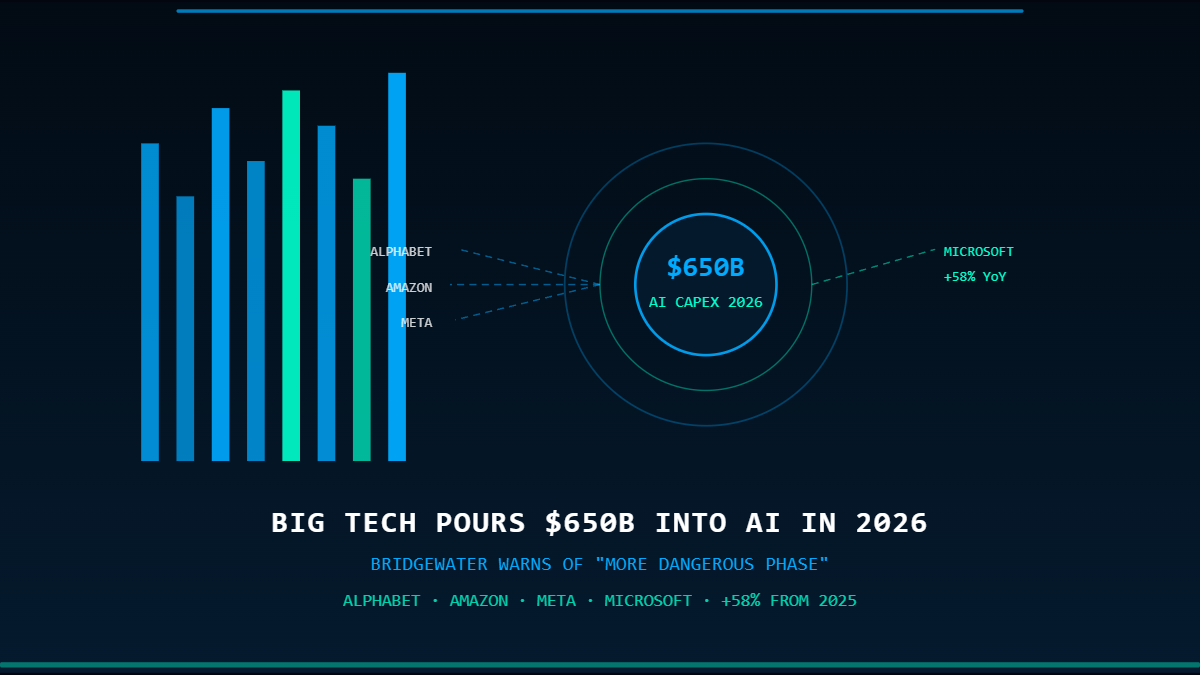
The numbers are in — and they are staggering. According to an analysis by Bridgewater Associates, U.S. technology giants Alphabet, Amazon, Meta, and Microsoft are expected to collectively invest approximately $650 billion to scale up AI-related infrastructure in 2026. That figure marks a 58% jump from the $410 billion these companies spent in 2025.
A “More Dangerous Phase” for AI
In a letter to clients, Bridgewater co-chief investment officer Greg Jensen described the artificial intelligence boom as having entered a “more dangerous phase,” marked by exponentially rising investments in physical infrastructure and a growing reliance on outside capital. Compute demand continues to significantly outpace supply, pushing hyperscalers to invest at an ever-accelerating pace in an attempt to stay ahead.
To fund this unprecedented surge in capital expenditure, all four companies have already begun curbing share buybacks more aggressively — redirecting capital toward data centers, AI chips, and energy infrastructure rather than returning it to shareholders. The scale of spending, Jensen warned, is creating significant downside risks if anything goes wrong.
Macro Implications: Growth, Inflation, and Risk
Bridgewater estimates that tech investment added roughly 50 basis points to U.S. GDP growth in 2025 and could provide around 100 basis points of support in 2026 — a meaningful contribution to the broader economy. However, the spending boom also carries macroeconomic risks. It may lift inflation in technology and communications equipment and push up electricity prices in certain regions as data center demand for power intensifies.
Jensen also raised the specter of a severe stock market correction that could undermine growth and limit companies’ ability to raise capital. He drew comparisons to the Dot-com bubble of 2000, though he noted that current market movements remain far smaller in scale. Still, the warning is clear: the more dependent the AI ecosystem becomes on rising valuations and outside capital, the more fragile it becomes.
What This Means for Cybersecurity and Enterprise Tech
For organizations in the cybersecurity and enterprise technology space, this investment wave has direct implications. As AI infrastructure scales, so does the attack surface. More APIs, more cloud dependencies, more autonomous systems — all of which require equally aggressive investment in security posture to match the pace of AI deployment. The organizations that treat security as an afterthought in the race to adopt AI will find themselves exposed at exactly the moment the threat landscape becomes most sophisticated.